


:quality(80)/p7i.vogel.de/wcms/3b/85/3b853d5a7c8fa5640146edb920e59526/pxl-20250616-161225541-mp-4032x2266v1.jpeg "Der BIOPOLYMER Kongress 2026 findet am 15. & 16. Juni in Halle (Saale) statt. Fachvorträge, Networking und der BIOPOLYMER Innovation Award für nachhaltige Kunststofflösungen. (Bild: PlastXnow)")
:quality(80)/p7i.vogel.de/wcms/a4/74/a4744b9ccd6b408173c422b918b8b11f/ulrich-reifenh-c3-a4user-3000x1688v1.jpeg "Nach 40 Jahren in führender Verantwortung hat sich Ulrich Reifenhäuser aus der operativen Geschäftsführung der Reifenhäuser Gruppe zurückgezogen. (Bild: Reifenhäuser)")
:quality(80)/p7i.vogel.de/wcms/72/66/72667830daf063f3e7d859498a6b0cbd/bild-2001-20gesch-c3-a4ftsf-c3-bchrung-20-c2-a9-20nexus-4032x2268v1.jpeg "Mit frischer Führung in die Zukunft: Gründer Dietmar Waizenauer (Mitte) Andreas Wurm (links) und Simon Ransmayr (rechts). (Bild: Nexus)")
:quality(80)/p7i.vogel.de/wcms/98/69/9869205e6343e4f9ee68360d25a0398e/aufmacher-799x449v1.jpeg "(Bild: Nataliia - stock.adobe.com/KI-generier)")
:quality(80)/p7i.vogel.de/wcms/42/0b/420bf691d7454a85327a80ad53c45b94/thumbnail-rado-online-strainer-1772x996v1.jpeg "Die Elastomermischungen werden auch feingestrainert. (Bild: Rado Gummi)")
:quality(80)/p7i.vogel.de/wcms/b9/cd/b9cd9b5b904a2b3df8c5aaa7b98edc2c/kraiburg-20gummiwerk-20vmq-5712x3210v1.jpeg "Die Silikon-Compound-Serie wurde für anspruchsvolle Anwendungen entwickelt. (Bild: Gummiwerk Kraiburg)")
:quality(80)/p7i.vogel.de/wcms/8d/22/8d224a120bec1c131fb630ba91178708/kraiburg-tpe-fr-1934x1087v1.jpeg "Kraiburg TPE entwickelte neue Thermoplastische Elastomere für hochwirksamen Brandschutz. (Bild: Kraiburg TPE)")
:quality(80)/p7i.vogel.de/wcms/85/59/855967f12a6f8ff1ed20371651cb1796/screenshot-202025-12-08-20130418-690x388v1.png "Static Coefficient of Friction (SCOF) Values under Various Conditions (Bild: )")
:quality(80)/p7i.vogel.de/wcms/ba/da/bada2c6c71c5232551c26cb5c7cc62e1/screenshot-202025-12-08-20131102-710x399v1.png "(Bild: )")
:quality(80)/p7i.vogel.de/wcms/32/08/3208424a642b590ef57370b2ebb4e665/screenshot-202025-12-08-20123833-946x532v1.png "Übersicht über gängige Elastomere (Bild: )")
:quality(80)/p7i.vogel.de/wcms/9f/ce/9fce39cae6873087a7a488e41b2c99ef/screenshot-202025-12-08-20125029-700x394v1.png "Demonstrator – sanitary sealing ring (Bild: )")
:quality(80)/p7i.vogel.de/wcms/13/4c/134c673ee6edc454febfc844a7ede791/bildunterschrift-201-uth-trp-blending-3024x1702v1.jpeg "Farbtest für gleichmäßiges, materialschonendes Blending zweier Reifen-Compounds im TRP-Prozess. (Bild: Uth)")
:quality(80)/p7i.vogel.de/wcms/07/56/075632bff9a9d7c9b5a44c50775c7d8b/aufmacher-g-c3-b6tz-scheibe-6000x3373v1.jpeg "Götz Scheibe von ACH Solution präsentiert am Engel-Stand auf der K 2025 eine GDL-Membrane für die Mobilität der Zukunft. (Bild: Engel Austria)")
:quality(80)/p7i.vogel.de/wcms/60/09/60095a181e6b56953727a6b89c362055/extruder-5472x3076v1.jpeg "Zwei unterschiedliche Extruder können an die mit Salzschmelze vulkanisierende Anlage angeflanscht werden. (Bild: Freudenberg Sealing Technologies)")
:quality(80)/p7i.vogel.de/wcms/58/d8/58d87b00fb0bcda2cc265da60eab6270/4-zentr--l-c3-bcftg-ger-c3-a4t-mit-w-c3-a4rmer-c3-bcck-und-kws-3507x1973v1.jpeg "Zentrales Lüftungsgerät mit Wärmerückgewinnung und Kaltwasserspeicher für die Hallenbelüftung. (Bild: Oni)")
:quality(80)/p7i.vogel.de/wcms/02/30/02306299c3bdf32e7b856bc4e0d205bf/tempro-20basic-20120-6635x3732v1.jpeg "Mit dem 3,5\"-TFT-LCD-Farbdisplay ist das Bedienen der Tempro basic Temperiergeräte noch einfacher. (Bild: Wittmann Gruppe)")
:quality(80)/p7i.vogel.de/wcms/4b/5b/4b5bc2686b3643dd079a03b312ee0608/reifen-labor-abrieb-1536x864v1.jpeg "Entwickelt wird im Zuge des Projekts „Teris“ eine Technologieplattform zur Erzeugung realitätsnahen
Gummiabriebs, dessen Analyse für Material- und Reifenentwicklungen und die Prognose für die digitalisierte Fahranalyse genutzt werden. (Bild: GPT Image Editor)")
:quality(80)/p7i.vogel.de/wcms/3b/9d/3b9d2095a8ebe7a56d7af8b1bc838d65/vdwf-azubi-up-01-5a70602339-1200x675v1.jpeg "Ziel der neuen online-Reihe des VDWF ist es, junge Talente frühzeitig abzuholen und sie mit Wissen für die Praxis zu stärken. (Bild: VDWF)")
:quality(80)/p7i.vogel.de/wcms/60/9d/609d1bf747c52a8a56a2f6ddf2144b43/deguma-walzwerk-aufmacher-367x206v1.jpeg "Ein Walzwerk nach der Überholung (Bild: Deguma)")
:quality(80)/p7i.vogel.de/wcms/23/34/23343ab8023801ac334b2f06fdeae24f/remberg-visual-copryright-remberg-5304x2983v1.png "Damit Künstliche Intelligenz echten Mehrwert schaffen kann, braucht sie eine saubere, vollständige und zugängliche Datenbasis. (Bild: Remberg)")
 ELASTOMERS AND PLASTICS
Application of Horikx’s Theory for devulcanized Scrap Rubbers
ELASTOMERS AND PLASTICS
Application of Horikx’s Theory for devulcanized Scrap Rubbers
End-of-life of scrap rubber is an important environmental issue. Many studies have tried to develop or to improve recycling methods by means of devulcanization processes, if possible in a continuous way. In this frame, the Horikx’s theory is widely used to characterize devulcanized rubbers especially as a method to assess the degree and the quality of the devulcanization process.
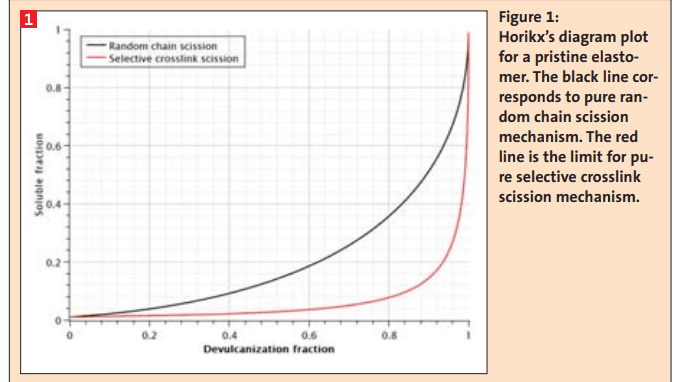
A lot of methods have been developed to regenerate waste rubber including thermomechanical, chemical, ultrasound assisted or microwave assisted processes. All the processes of reclaiming aim at transforming the three-dimensional network in a structure that gives thermoplastic behaviour to the material. This new structure is tricky to characterize because of the presence of a residual network, or clusters with various degrees of cross-linking and a collection of free polymer chains with different sizes and architectures.
Sie haben bereits ein Konto? Hier einloggen