


:quality(80)/p7i.vogel.de/wcms/bd/58/bd581e3ef946e8834086ce4b545f233b/edited-photo-5-1782x1003v1.png "Vertreter von Assogomma, Consorcio und Elanova zusammen mit dem Präsidenten von Tyres Europe, Livio Magni (4.v.l.), und dem Generalsekretär Adam McCarthy (r.) bei der Unterzeichnung am 2. September 2026 in Brüssel. (Bild: Tyres Europe)")
:quality(80)/p7i.vogel.de/wcms/5d/e8/5de8fcf121dcb2ce886d2dcfe542e230/maxresdefault-1280x719v1.jpeg "Mit der Übernahme der M+R Dichtungstechnik festigt Trelleborg seine Marktstellung im DACH-Raum. Das erfahrene M+R-Team in Seligenstadt bleibt laut Trelleborg erhalten. (Bild: M+R Dichtungstechnik)")
:quality(80)/p7i.vogel.de/wcms/74/1b/741bd5a76f893f7aa5a13ff45adb5ee8/continental-zevra-tire--9-1920x1079v1.jpeg "Der ZEvRA Konzeptreifen von Continental besteht zu rund 43 % aus recycelten Materialien. (Bild: Continental)")
:quality(80)/p7i.vogel.de/wcms/7c/90/7c90496a4680447674d7f7e32d160367/herbert-baaser-5-1371x771v1.jpeg "Prof. Dr.-Ing. Herbert Baaser, Geschäftsführer der Deutschen Kautschukgesellschaft (DKG). (Bild: DKG)")
:quality(80)/p7i.vogel.de/wcms/1e/04/1e04e410d83b193519e83cbc2a7566ff/silpuran-medical-adhesives-2303x1295v1.jpeg "Wacker stellte kürzlich ein auf Biomethanol basierendes Silikonadhäsiv vor, das besonders ressourcen- und klimaschonend produziert wird. Silpuran Eco 2114 erreicht eine hohe Haftkraft und eignet sich vor allem als Klebstoff für Wundauflagen und Fixierhilfen. (Bild: Wacker)")
:quality(80)/p7i.vogel.de/wcms/42/0b/420bf691d7454a85327a80ad53c45b94/thumbnail-rado-online-strainer-1772x996v1.jpeg "Die Elastomermischungen werden auch feingestrainert. (Bild: Rado Gummi)")
:quality(80)/p7i.vogel.de/wcms/b9/cd/b9cd9b5b904a2b3df8c5aaa7b98edc2c/kraiburg-20gummiwerk-20vmq-5712x3210v1.jpeg "Die Silikon-Compound-Serie wurde für anspruchsvolle Anwendungen entwickelt. (Bild: Gummiwerk Kraiburg)")
:quality(80)/p7i.vogel.de/wcms/28/bc/28bc53fd9ce0bdf78ebd71260ac5514d/orion-1-1920x1080v1.jpeg "Praxisnahe Einblicke: Der WBS-Jahrgang informiert sich im Rahmen der „Westtour“ über die Herstellung von Industrierußen sowie die dazugehörige Anlagen- und Verfahrenstechnik. (Bild: Deutsches Institut für Kautschuktechnologie e. V. (DIK))")
:quality(80)/p7i.vogel.de/wcms/b1/fc/b1fc64dd9e8ac91d472add6b87c25ce2/img-0542-3946x2218v1.png "Die Organisatoren der Tagung: Josef Ludwig, Ulrike Weber und Dr. Jens Meier (v.l.). Dr. Meier führte als Gastgeber vom DIK und Leiter der DKG-Regionalgruppe Nord durch das Programm. Er wurde dabei von Ludwig (Firma LNP) unterstützt. Weber von der Frankfurter DKG-Geschäftsstelle informierte über aktuelle bundesweite Projekte und Aktivitäten der DKG. (Bild: KGK/Gutbrod)")
:quality(80)/p7i.vogel.de/wcms/e9/cd/e9cd336e5a7a32bc3be55f8364b4ef8a/00292202-1516x853v1.png "Ein wesentlicher Hebel für die Kreislaufwirtschaft ist die Integration von Design for Recycling bereits in der Phase der Polymerformulierung. (Bild: Michelin)")
:quality(80)/p7i.vogel.de/wcms/80/bc/80bcfb071d0b136eeb3e00a006832fbb/2026--2002--2013--20fraunhofer-20imws-20aufmacher-3024x1701v1.jpeg "Der Inline-Reifenabnutzungssensor nach dem Einbau in einen Lkw-Reifen. (Bild: Rösler)")
:quality(80)/p7i.vogel.de/wcms/73/f4/73f420829754888ba4acc0f6e436c15c/prmpr020-visco-p-inline-viscometer-1920x1080v1.jpeg "Das Inline-Viskosimeter \"Visco P\" ist neu mit komplettem Regelkreis erhältlich und ermöglicht in Kombination mit einem Dosiergerät die Regelung eines Additivs auf Basis der im Produktionsprozess gemessenen Viskosität. (Bild: Promix)")
:quality(80)/p7i.vogel.de/wcms/63/f6/63f682801025b06be7c3e85215b33436/tartler-0726-1-1920x1080v1.jpeg "Tartler-System für die Materialvorbereitung der A- und B-Komponente zur Herstellung medizintechnischer Silikonteile. Die Anlage hat vier Mischköpfe, wobei jedem Kopf eine separate Farbpaste zudosiert wird. So muss bei einem Farbwechsel nichts gereinigt oder gespült werden. (Bild: Tartler)")
:quality(80)/p7i.vogel.de/wcms/cd/62/cd62bfed185488caa7f2a01e3c836c14/image-01-fakuma-2026-vce-220-lsr-bauteil-01-1920x1079v1.jpeg "Eine Dichtung mit Nullfehler-Anspruch: Die 484 x 202 x 29 mm große LSR-Dichtung schützt empfindliche Elektronik in Wechselrichtern zuverlässig vor Feuchtigkeit. (Bild: Engel)")
:quality(80)/p7i.vogel.de/wcms/5b/5c/5b5c5b57adb9d71567efa0345d33ec7c/weltpremiere-lwb-multistation-revolution-f-r-die-gummifertigung-1920x1079v1.jpeg "Weltpremiere LWB Multistation: Stillstandzeiten in der Kautschukverarbeitung minimieren (Bild: Shibaura Machine LWB)")
:quality(80)/p7i.vogel.de/wcms/8c/b5/8cb54ca58b25c03b976310bc0e8f5856/csm-2026-0066-elmet-smartshot-i-fakuma-image-a76fbd7318-732x412v1.jpeg "Smartshot i ist intelligente Kaltkanaltechnik für den LSR-Spritzguss. (Bild: Elmet)")
:quality(80)/p7i.vogel.de/wcms/02/30/02306299c3bdf32e7b856bc4e0d205bf/tempro-20basic-20120-6635x3732v1.jpeg "Mit dem 3,5\"-TFT-LCD-Farbdisplay ist das Bedienen der Tempro basic Temperiergeräte noch einfacher. (Bild: Wittmann Gruppe)")
:quality(80)/p7i.vogel.de/wcms/4b/5b/4b5bc2686b3643dd079a03b312ee0608/reifen-labor-abrieb-1536x864v1.jpeg "Entwickelt wird im Zuge des Projekts „Teris“ eine Technologieplattform zur Erzeugung realitätsnahen
Gummiabriebs, dessen Analyse für Material- und Reifenentwicklungen und die Prognose für die digitalisierte Fahranalyse genutzt werden. (Bild: GPT Image Editor)")
:quality(80)/p7i.vogel.de/wcms/3b/9d/3b9d2095a8ebe7a56d7af8b1bc838d65/vdwf-azubi-up-01-5a70602339-1200x675v1.jpeg "Ziel der neuen online-Reihe des VDWF ist es, junge Talente frühzeitig abzuholen und sie mit Wissen für die Praxis zu stärken. (Bild: VDWF)")
:quality(80)/p7i.vogel.de/wcms/63/5b/635b44caeca087959e3360e54e785bf9/bild1-bareiss-7488x4208v1.png "Unter dem Motto „The Future has a Pulse“ präsentiert Bareiss seinen neuen Pulsed Mechanical Analyzer (PMA) erstmals der Öffentlichkeit. (Bild: Bareiss)")
:quality(80)/p7i.vogel.de/wcms/43/4e/434e4c7968383b54a583cd5f88bf1c7a/maddox-ai-bildschirmmockup-wire-quality-300dpi-2480x1395v1.jpeg "Bereits kleinste Änderungen im Prozess können sichtbare Veränderungen auf der Produktoberfläche erzeugen. Diese Effekte sind technisch meist unkritisch, erschweren aber die automatisierte Inspektion erheblich. (Bild: Maddox AI)")
:quality(80)/p7i.vogel.de/wcms/23/34/23343ab8023801ac334b2f06fdeae24f/remberg-visual-copryright-remberg-5304x2983v1.png "Damit Künstliche Intelligenz echten Mehrwert schaffen kann, braucht sie eine saubere, vollständige und zugängliche Datenbasis. (Bild: Remberg)")
 ELASTOMERS AND PLASTICS
Preparation and Properties of high strength Composite Fibers from UHMWPE and Carbon Nanotubes
ELASTOMERS AND PLASTICS
Preparation and Properties of high strength Composite Fibers from UHMWPE and Carbon Nanotubes
CNT`s were mixed with ultra high molecular weight polyethylene (UHMWPE) in paraffin oil to form nanocomposite gel. The concentration of UHMWPE was fixed at 3% by weight and the amount of CNT was 5% of UHMWPE.
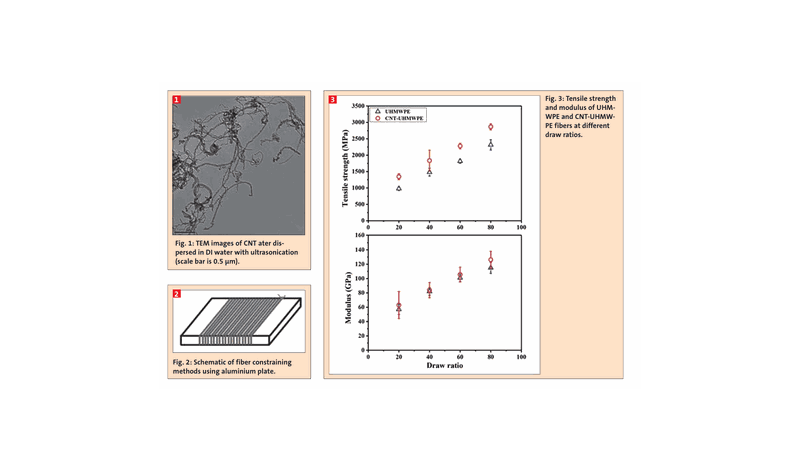
Polymer chains are intrinsically strong and highly anisotropic but these properties are often not seen in polymer products due to the random coiling and/or chain folding of the chains. It has been known for a long time that drawing a polymer into fiber under appropriate condition would lead to a stronger polymer fiber. Also, the theoretical modulus and strength of many common polymer molecules were calculated long ago from very simple principle (see [1] for example] and the values regularly updated using advanced tools in each period of time [2].
Sofort weiterlesen mit
473 € / Jahr
-
Alle Inhalte lesen
-
Alle E-Paper inklusive
-
Jederzeit online kündbar
SSL-Verschlüsselung